Gloria’s Alzheimer’s Disease
A Dog's JourneyGloria’s Alzheimer’s Disease is shown not as a steady, easily understood decline but through changing degrees of lucidity, an increasingly unresponsive state, and the intimate work of staying beside her. Its effects are inseparable from her relationship with CJ: care continues amid accusations about money and a house, while neither the illness nor the family conflict is reduced to a simple explanation for the other.
Course and lived presentation
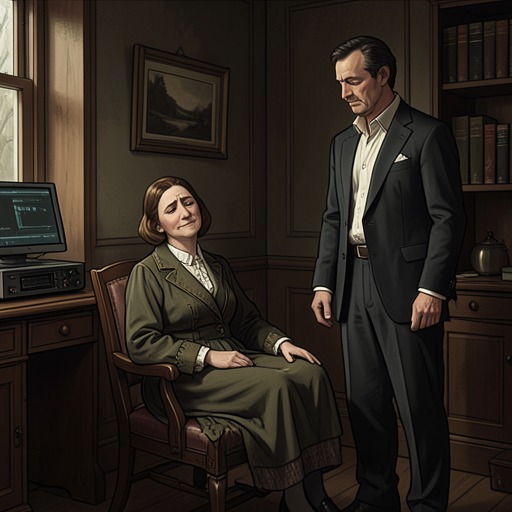
CJ describes Gloria as having good days and bad days, with the day of their conversation being comparatively good. Most of the time, she says, Gloria is not really lucid. Fran identifies the course as inconsistent, remarking that Alzheimer’s can be cruel in part because its progression does not follow a reliable pattern. The account gives no clinical timetable or further diagnostic detail; instead, it makes variability itself central to how the illness is experienced by those around Gloria.
Later, CJ describes a more severe change: Gloria has become increasingly unresponsive and has nearly stopped eating. CJ struggles to accept that this is truly the end. The contrast between the earlier “pretty good day” and this later condition makes the decline legible through changes in Gloria’s presence and responsiveness, rather than through a single clearly marked turning point. CJ’s difficulty adjusting also shows that recognizing a decline intellectually does not make its finality emotionally easier to bear.
Gloria and CJ: illness amid unresolved conflict
The account of Gloria’s condition is entangled with a dispute over money and the family home. CJ says Gloria tells people that CJ stole her fortune and her house. CJ counters that she has supported Gloria for the past fifteen years, and that whatever money she sent was never enough. The narrative presents the accusation and CJ’s account together, but does not establish that Alzheimer’s alone caused the accusation or settle every aspect of the underlying financial history.
For CJ, the conflict is painful even as she continues to care. Fran observes that situations like this often contain unresolved issues; CJ acknowledges that she should be better able to cope, adding that she is a psychologist. Her professional identity does not protect her from the strain of her mother’s illness or make their history easier to resolve. The scene holds two realities at once: Gloria needs care, and CJ carries the hurt of being portrayed as someone who took from her when CJ says she has spent years supporting her.
The final decline and death
About a week after the conversation about Gloria’s worsening condition, Toby senses a change while sitting at CJ’s feet in Gloria’s room. He hears Gloria’s breathing grow lighter, stop, and resume in a few deep breaths; each cycle becomes weaker, with gentler exhalations. The passage follows the change through Toby’s close attention to sound and bodily presence, making the moment gradual rather than instantaneous.
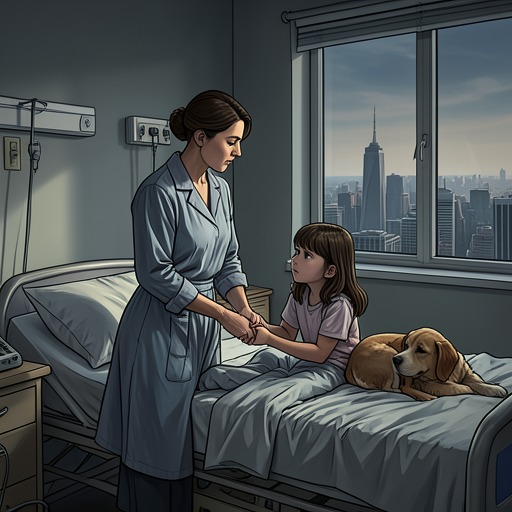
Gloria’s eyes are closed, her mouth open, and her hands clasped across her chest. CJ is asleep, so Toby barks once to wake her. CJ comes to Gloria’s side, takes her hand, and says goodbye, telling her she loves her. She remains beside her mother for several minutes, crying, until Gloria takes her last breath. Afterward, CJ returns to her chair; Toby settles into her lap while she holds and rocks him as she grieves. The illness’s ending is thus also a moment of care passing between mother and daughter, and then from Toby to CJ.
Narrative perspective and significance
Gloria’s condition is filtered largely through what others notice and say: CJ reports the fluctuations in lucidity and the accusations, Fran names the inconsistency of the progression, and Toby attends to changes in breathing and to CJ’s distress. This perspective does not claim access to Gloria’s private experience. Instead, it records how her illness reshapes the understanding and actions of people close to her.
The illness also brings unresolved family matters into the foreground without resolving them before Gloria dies. CJ’s account of fifteen years of support sits beside Gloria’s accusations; her recognition that the end is near sits beside her difficulty accepting it. Toby’s single bark becomes crucial because it allows CJ to be present for her mother’s last moments. Alzheimer’s is therefore portrayed both as a changing condition and as a context in which attention, responsibility, grief, and unfinished affection endure to the end.